
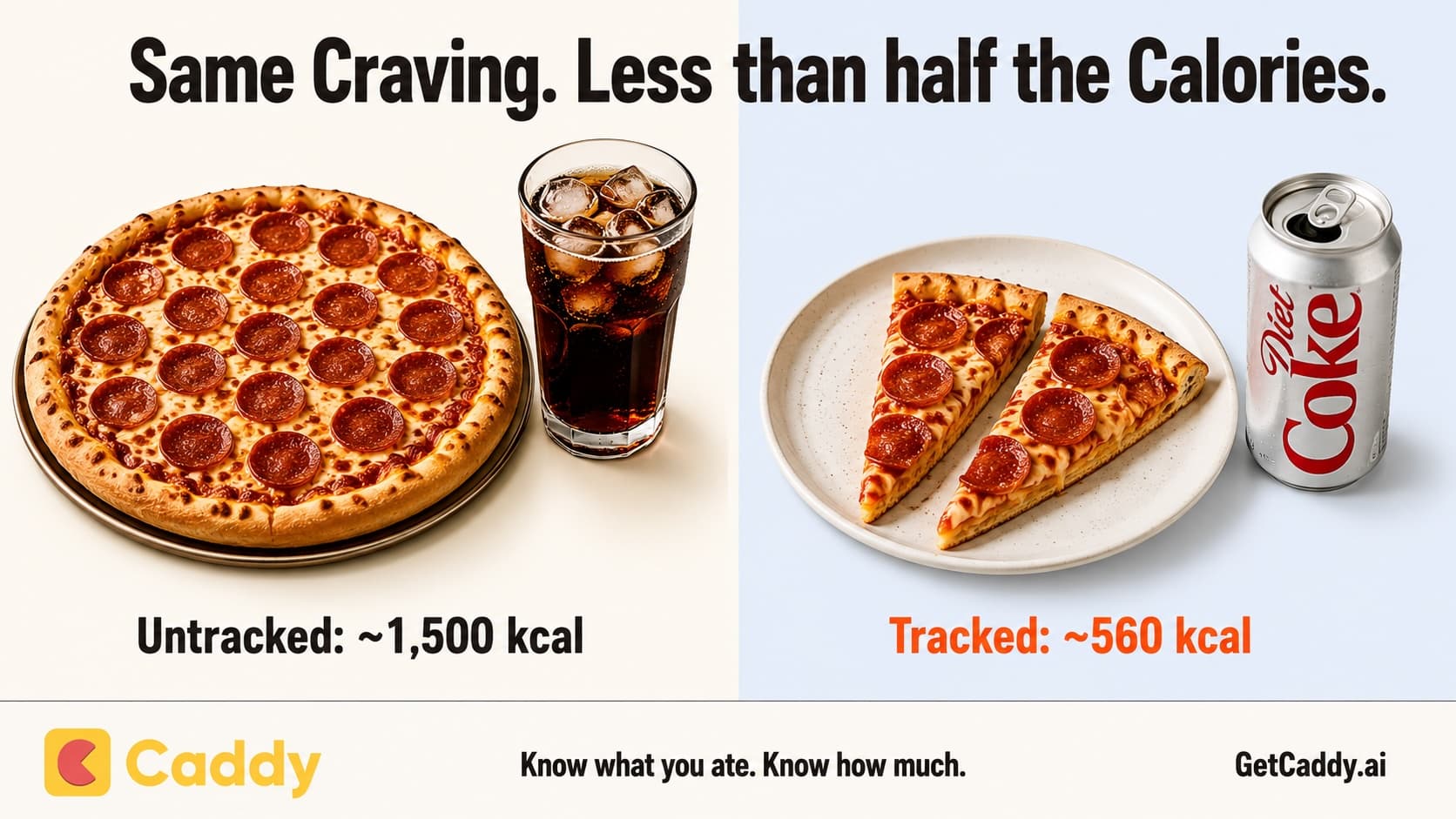
Same Craving, Half the Calories: The Cheat Meal Swap That Actually Works
Written by Rishi Bhojnagarwala
Nutrition Reviewed by Dr. Hetal Pal, PhD in Nutrition Science
You don't need to skip the pizza. You need to see it before you finish it.
The Same Meal, Two Ways
Picture a typical cheat meal: a whole medium pepperoni pizza, six slices, with a regular Coke on the side. A medium hand-tossed pepperoni slice runs roughly 200–300 calories, so six slices land around 1,500 calories on their own. Add a 300ml regular Coke — Coca-Cola's own India nutrition label puts it at 44 kcal per 100ml, so about 130 calories — and the whole meal comes to roughly 1,630 calories.
Now picture the same craving, handled differently: half the pizza — three slices, about 750 calories — with a Diet Coke instead. Coca-Cola labels Diet Coke at less than 1 calorie per serving. Total: roughly 750 calories.
Same flavour. Same meal. Same satisfaction, arguably — you're not eating a salad instead of what you were craving. What changed is that one version was seen in full before it was eaten, and the other wasn't.
That's not a diet trick. It's two swaps, and the second one — diet instead of regular — barely registers as a change in taste at all.

We asked Deniz Ayşen Demir, a dietitian at Erdem Hospital, whether the "diet soda is bad for you" concern holds up for someone using it this way:
I think this issue gets overblown sometimes, especially when the alternative is beverages sweetened with sugar. Drinking low or no sugar drinks instead of sugary ones can lead to a little bit of weight loss. There is some data on this. Even if it's minimal, this is definitely a stepping stone in the right direction. But I wouldn't want people to drink diet soda instead of water all day. Even the World Health Organization does not recommend sweeteners as a long-term weight control strategy. Personally, I would rather see someone enjoy a diet soda with lunch once in a while than to force himself or herself to follow a perfect diet and then drink a large regular soda later on.
— Deniz Ayşen Demir, Dietitian, Erdem Hospital
Why This Isn't Deprivation
Nobody's being asked to eat a salad instead of what they were craving. Half a pizza is still pizza. A Diet Coke still tastes like a treat, poured over ice, with the same fizz. The only thing that shifted is that the decision got made before the plate was empty instead of after.
There's a real reason this framing works better than "just eat less pizza." Research on dietary restraint styles — most notably Westenhoefer, Stunkard and Pudel's landmark 1999 study, later replicated across tens of thousands of participants — found that rigid control (all-or-nothing rules, guilt after any "forbidden" food) is associated with higher BMI and more frequent binge eating, while flexible control — conscious portioning, adjusting rather than banning — predicts lower BMI, less binge eating, and better long-term weight maintenance. The mechanism isn't complicated: a hard rule that gets broken tends to break completely. A visible number that gets adjusted just gets adjusted.
That pattern holds up in clinical practice too, not just research. We asked Deniz whether clients who track cheat meals actually eat less over time than clients who try to avoid them entirely:
Generally yes. Not every person is the same, of course, but a good number of people actually do better when certain foods are not "forbidden." So, for example, eating pizza or dessert once in a while is far better than going without it completely and binging on it when the occasion arises. I prefer to call this a "planned" meal rather than a "cheat" meal, because food shouldn't come with guilt. For most people, keeping their eating habits consistent throughout the week is much more important than having the occasional ice cream.
— Deniz Ayşen Demir, Dietitian, Çamlıca Erdem Hospital
Cheat Smart, Not Blind
This is the same principle behind one of the most useful habits in weight loss: cheat meals don't reliably derail progress. Untracked cheat meals do — not because of the meal itself, but because of what tends to happen next. One slice becomes the whole pizza. One regular Coke becomes "well, today's ruined anyway, might as well." That spiral is the rigid-restraint pattern the research above describes, and a visible number breaks it before it starts, because there's no all-or-nothing threshold to cross.
Deniz sees this exact spiral in practice, and what actually stops it:
We've all been there. Occasionally, you'll have a burger and think you've ruined your diet and go crazy. One burger becomes a side of fries, then comes a sugary drink, and then dessert. Sometimes you tell yourself you'll go back on a diet on Monday, so you eat without any limits the entire weekend. There is a flip side to this though. We all know that overly strict diets, skipping meals and avoiding certain foods actually contribute to binge eating later on for some people. You should not punish yourself and starve yourself to make up for a slip up. That is why it is best to eat normally, decide what you want to splurge on, keep it reasonable and then get back to your routine.
— Deniz Ayşen Demir, Dietitian, Çamlıca Erdem Hospital
Tracking a cheat meal isn't about restriction. It's about making the swap — half instead of whole, diet instead of regular — an actual choice instead of something that happens by default because nobody was counting.

This Works Beyond Pizza
The pizza-and-Coke example is clean because the math is so exact, but the same two-swap logic applies to most cheat meals:
Burger and fries. A regular-size portion of fries next to a smaller portion, plus a diet soda instead of regular, typically cuts several hundred calories without touching the burger itself — usually the part of the meal people actually crave.
Biryani. A full plate versus a smaller plate with raita instead of extra fried onions or a side of naan, keeps the dish exactly what it is while trimming the calorie-dense extras that get added on top.
Dessert with a meal out. Sharing a dessert three ways instead of ordering one each does more for the calorie total than skipping dessert entirely does for willpower — and it's far more sustainable across repeated Fridays.
The pattern is always the same: keep the food that's actually the craving, trim the parts that were added by default rather than by choice, and see the number before deciding how much of it to finish.
What Tracking Actually Does Here
This is the real value of logging a cheat meal, and it has almost nothing to do with restriction. Seeing "1,630" next to "750" before you eat either version is what turns an automatic default into an actual decision. Without that number, most people default to the higher-calorie version simply because it's the one in front of them — not because they consciously chose it over the alternative.

How Caddy Fits Into This
Log the cheat meal exactly as you're about to eat it, and see the number before you decide how much of it to finish. Score 8 doesn't care whether today's calories came from a salad or a pizza — it just tells you whether the day, cheat meal included, added up to a deficit.
Know what you ate. Know how much.
Score 8. Lose weight. That's it.
Sources
Frequently Asked Questions
- How many calories does a cheat meal like pizza and soda actually have?
- A whole pepperoni pizza with a regular soda can easily total around 1,500 calories, depending on size and toppings. Simple swaps — a smaller portion and a diet soda — can bring that down to roughly 800 calories without changing what you're eating.
- Do I have to give up pizza and soda to lose weight?
- No. The goal isn't elimination — it's visibility. Tracking a cheat meal before you finish it lets you make small, satisfying swaps (like half a portion or a diet drink) instead of guessing afterward.
- Why does tracking cheat meals matter more than tracking regular meals?
- Cheat meals are where portions and choices tend to drift the most, often without anyone noticing in the moment. A visible calorie count during the meal — not after — is what makes a smart swap possible.
- What's the difference between a cheat meal that helps and one that hurts progress?
- A tracked cheat meal, even a generous one, fits into your day's numbers. An untracked one often triggers a "today's already ruined" mindset that leads to eating well beyond the original cheat meal — that spiral, not the meal itself, is what typically causes setbacks.
- Does diet soda actually make a meaningful calorie difference?
- Yes — a regular soda can carry 140-150 calories, while a diet version carries close to zero. Swapped into a cheat meal, it's one of the simplest changes that meaningfully lowers the total without changing what you're eating.
Get Caddy
Your simplest way to eat smarter with Indian food
Download