
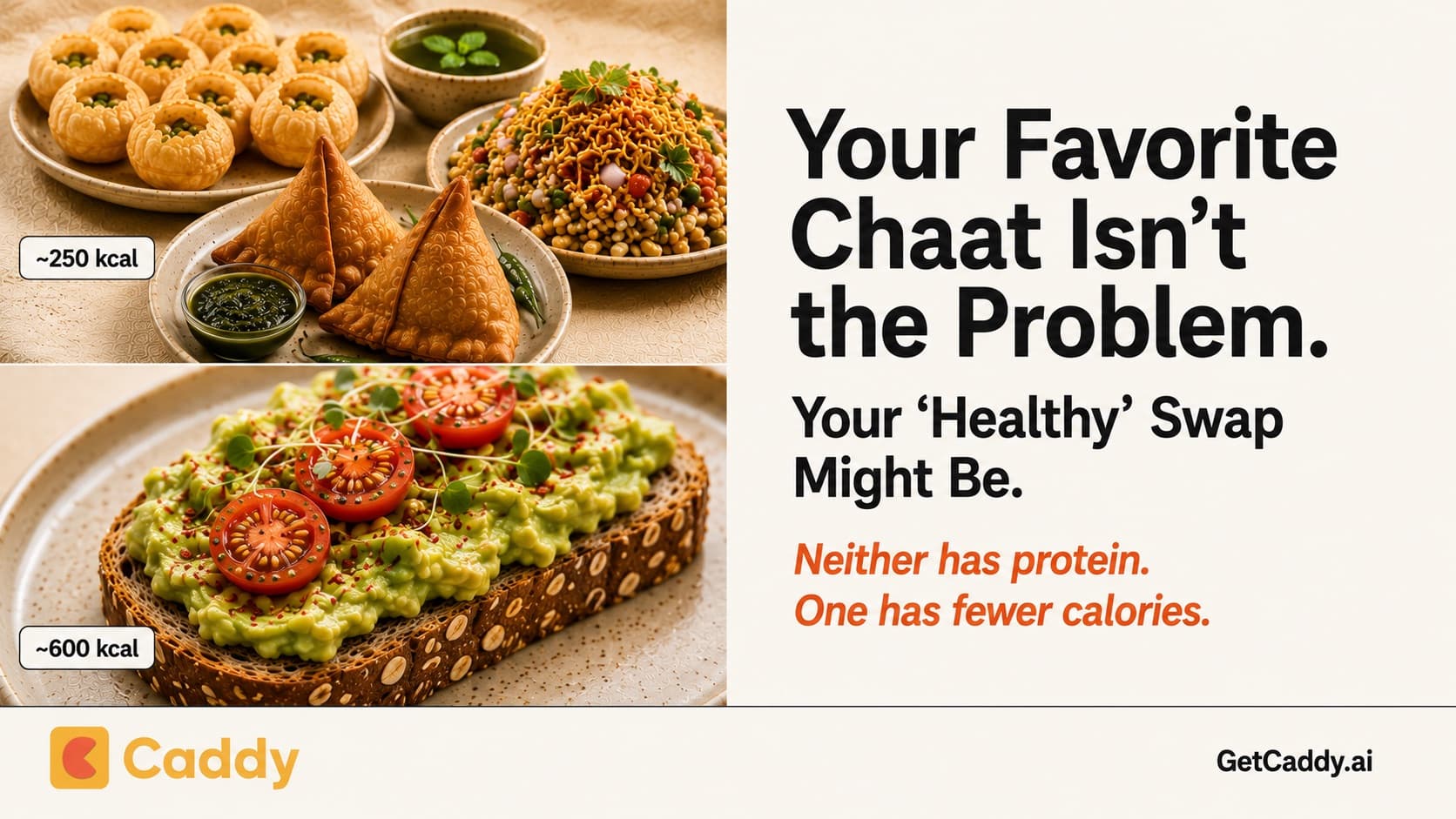
Your Favorite Chaat Isn't the Problem. Your "Healthy" Swap Might Be.
Written by Rishi Bhojnagarwala
Nutrition Reviewed by Dr. Hetal Pal, PhD in Nutrition Science
Food is meant to be enjoyed. Nobody actually wants to live on bland salads forever, and the good news is: with the right data, you don't have to choose between nutritious and delicious. You just have to know the numbers.
What Your Favorite Street Food Actually Costs
Pani puri, sev puri, bhel puri, and a classic samosa all land in roughly the same place: 200-300 calories for a standard plate or piece, per Bon Happetee's Indian food database. That's not a diet-friendly rounding trick — it's just what the ingredients add up to. A pani puri plate (6 pieces) typically runs 200-300 calories, sev puri sits around 280-290, a bowl of bhel puri is usually 250-315, and a single samosa is about 245-260.
Real vendor-to-vendor variation exists — more oil, more chutney, bigger puris all push the number up — but the range holds. This is a satisfying evening snack, genuinely food for the soul, sitting at a calorie count most people would guess is way higher.

What the "Healthy" Alternative Actually Costs
Here's where it gets interesting. The snacks people swap in instead of chaat, assuming they're the responsible choice, often cost more.
Avocado toast — the actual café version, two slices with a real amount of avocado, oil, and toppings — commonly runs 500-700 calories, not the dainty 300 people picture. Half an avocado alone is 120-150 calories before the bread, oil, or toppings even enter the picture.
Mixed nuts are the same story, just quieter about it. The "official" recommended serving is 30 grams — about 180 calories — but almost nobody actually measures out 30 grams into a bowl. A real snacking portion, the kind you eat while watching something, is closer to 60-80 grams, which puts you at 450+ calories before you've noticed.

A loaded Greek yogurt and granola bowl — fruit, nut butter, a honey drizzle, a generous scoop of granola — commonly lands between 400 and 600 calories, depending on how generous the toppings are. It reads as the most virtuous breakfast option on the table and is frequently the most calorie-dense.
The Protein Gotcha
Here's the part that makes this genuinely funny once you see it: people dismiss chaat with "yeah, but it has no protein" — which is true. Pani puri, bhel, sev puri, samosa: minimal protein across the board.
But avocado toast doesn't either. A standard slice comes in around 6-11 grams of protein depending on toppings — not nothing, but not the redemption arc people assume it is. Mixed nuts have some protein, but you'd need to eat an amount that blows past 500+ calories to get a meaningful dose. Protein is treated as the automatic justification for "healthy," and in this specific matchup, neither side is bringing much of it to the table. Most people are getting their actual protein intake from elsewhere in the day anyway — a shake, dal, eggs, paneer — which makes the protein argument against chaat specifically a bit of a red herring here.

So What Do You Actually Do With This
Once protein is off the table as the deciding factor, the decision gets a lot simpler: pick the option with fewer calories. Sometimes that's the samosa. Sometimes it's the bhel puri instead of the granola bowl. It's not about virtue, it's arithmetic.
This is the whole point of tracking what you actually eat instead of what a food looks like it should cost. Healthy eating doesn't mean saying no to the things you love — it means knowing how to say yes wisely. Don't swap the chole bhature for idli, or your favourite samosa for a boring bowl of poha, out of guilt over a number you never actually checked.

About Caddy
Caddy is a nutrition and weight-loss companion built for Indians who'd rather know the real number than guess based on what looks "healthy."
Know what you ate. Know how much.
Score 8. Lose weight. That's it.
Sources
Frequently Asked Questions
- Is pani puri actually healthy for weight loss?
- A standard plate (6 pieces) is typically 200-300 calories, which fits comfortably into most calorie budgets. It's not high in protein or fiber, but calorie-wise it's far more modest than most people assume.
- Is avocado toast really higher calorie than chaat?
- Often, yes. A real café-style serving — two slices with a proper amount of avocado, oil, and toppings — commonly runs 500-700 calories, well above a plate of pani puri, bhel, or a samosa.
- Does chaat have any protein?
- Very little. Pani puri, bhel puri, sev puri, and samosa are primarily carbohydrate and fat, with minimal protein from ingredients like chickpeas or potato filling.
- If chaat has no protein, why compare it to avocado toast at all?
- Because avocado toast doesn't have much protein either — typically 6-11 grams per serving. If protein isn't meaningfully present on either side, it's not actually the deciding factor, so calorie count becomes the more useful comparison.
- How many calories are really in a bowl of mixed nuts?
- The standard serving is 30 grams (about 180 calories), but a realistic snacking portion is often 60-80 grams — 450+ calories — since nuts are rarely portioned out with a scale.
Score 8 to lose weight
Your simplest way to eat smarter with Indian food
Get Caddy