
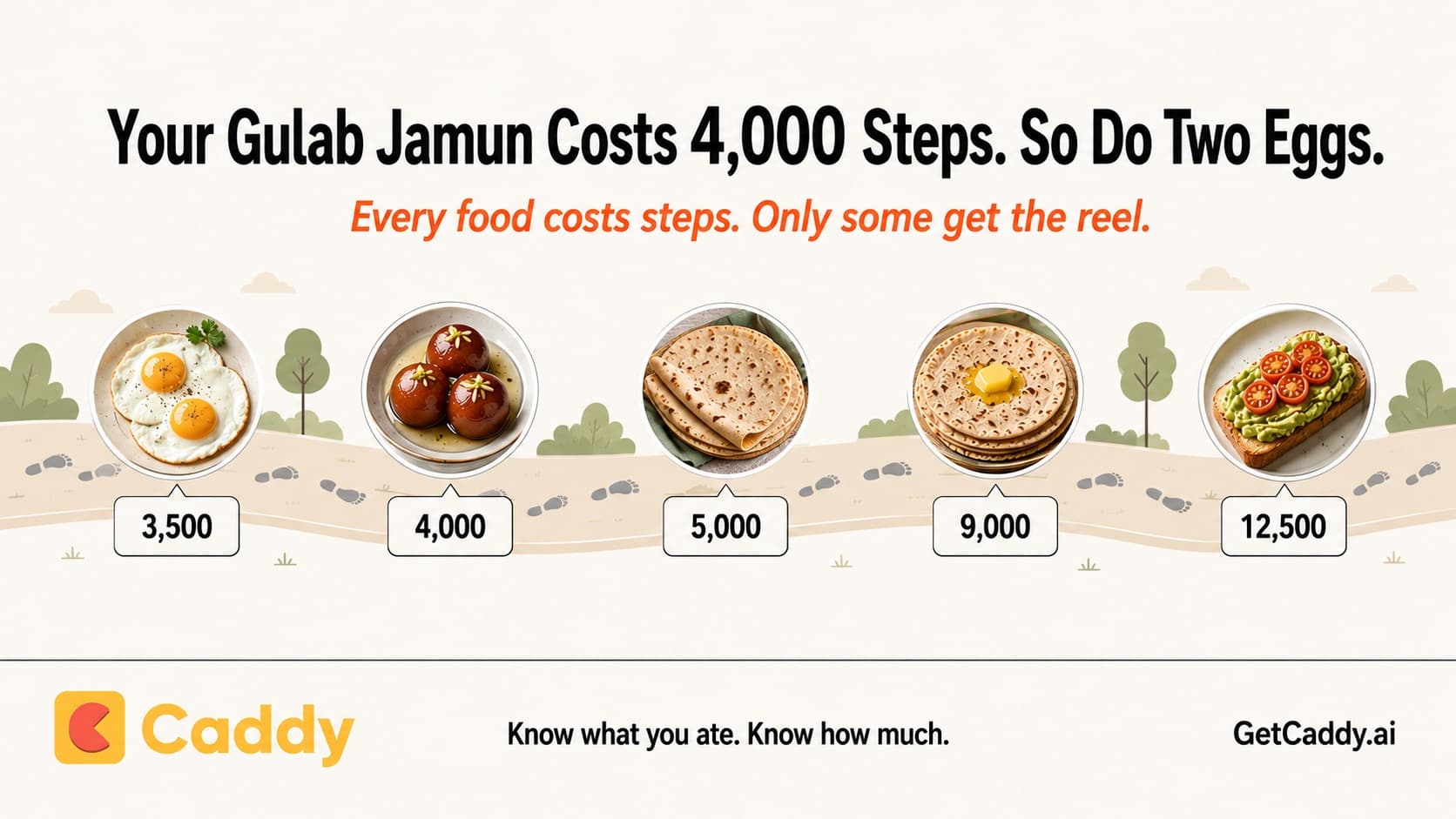
Your Gulab Jamun Costs 4,000 Steps. So Do Two Eggs.
Written by Rishi Bhojnagarwala
Nutrition Reviewed by Dr. Hetal Pal, PhD in Nutrition Science
You've seen the format. A coach holds up a gulab jamun to the camera. "Do you know how many steps it takes to burn this? Five thousand." Cut to a samosa. Seven thousand. Cut to a bowl of ice cream. Four thousand. The message underneath is never stated but always clear: this food is a debt, and you're going to have to work it off.
The math isn't wrong. That's the frustrating part. It's the list that's dishonest.
Finishing the List They Started
Walking 10,000 steps burns roughly 300 to 500 calories for most adults, depending on weight, pace, and stride. Call it 400 as a working average — that's about 25 steps per calorie.
Run that conversion across a normal day of eating, not just the foods that photograph guiltily, using Bon Happetee's Indian food database:
Two plain rotis cost more steps than a gulab jamun. Two rotis with ghee cost more than twice as much. The avocado toast — the one that gets posted on Sunday mornings with the caption about self-care — costs more than any sweet on the list, by a wide margin.
Nobody is making that reel.

This Isn't a Gotcha About the Arithmetic
To be clear: the coaches doing this aren't lying about the numbers. A gulab jamun really does take about 4,000 steps to burn off. The conversion is real.
The problem is that the conversion is universal and the framing is selective. Every food that contains energy requires movement to burn. That includes the ones on your "good" list. Grilled chicken has calories. Brown rice has calories. Ghee absolutely has calories, and more per gram than almost anything else on your plate. Applying step-math only to foods that are already culturally coded as indulgent doesn't teach anyone how energy balance works. It just teaches them to feel bad about mithai.
And it sets up a genuinely damaging idea: that food is a debt and exercise is the repayment. That's not how bodies work, and it's not a sustainable way to think about eating for the next forty years.
What Your Body Is Actually Doing All Day
Here's the number that reframes the entire conversation.
Your body burns roughly 2,000 calories a day doing essentially nothing. Not walking. Not exercising. Lying in bed, watching Netflix, breathing, thinking, keeping your organs running. This isn't a Caddy claim — 2,000 calories a day is the reference the FDA uses as its general guide for nutrition advice, printed on every packaged food label you've ever picked up. Your personal number varies with age, sex, size, and activity, but 2,000 is the working average, and it's the baseline everything else is measured against.

Now compare that to the 400 calories you'd get from 10,000 steps. Your resting metabolism does five times more work than a full day of dedicated walking. The steps matter — for your heart, your head, your longevity, your blood sugar — but as a calorie-burning strategy, they're a rounding error next to what your body already burns for free.
Which means the lever that actually moves weight isn't on the walking side of the equation. It's on the eating side.
Where Weight Loss Actually Comes From
To lose weight, you need to consistently eat less than you burn. That's the whole mechanism, and no amount of ingredient-swapping changes it.
Against a roughly 2,000-calorie baseline, landing somewhere between 1,200 and 1,600 calories a day — where exactly depends on your body, your starting point, and what a doctor or your own tracking data tells you — puts you in a deficit that translates to a meaningful 2 to 3 kg a month. That's a sustainable, unglamorous rate. It's also the rate that actually stays gone.
Notice what's not in that calculation: any specific food. Not the gulab jamun. Not the samosa. Not the rice you were told to cut.
The Occasional Sweet Was Never the Problem
Here's the arithmetic nobody makes reels about.
One gulab jamun at a wedding is about 160 calories. Once. Even if you have three, and you have them at four weddings a year, you're looking at under 2,000 calories across an entire year. That's not a rounding error in your annual intake — it is the rounding error.
Now consider the extra spoon of ghee on your daily roti. The handful of namkeen at 6pm that you don't really register eating. The second helping you take without deciding to. The oil in the sabzi that's genuinely double what you'd estimate. That's 300 to 400 calories a day. Every day. Which is roughly 120,000 calories a year, or somewhere around 15 kg of accumulated weight gain.
The sweet you feel guilty about is measured in occasions. The thing actually driving the outcome is measured in daily habit — and it's almost always invisible fat and portion size, not the dessert you can clearly see and clearly remember.

Food Is Not a Mistake. Walking Is Not a Punishment.
The step-shaming format gets one thing exactly backwards. It treats eating as the transgression and movement as the penance.
Walk because it's good for your heart and clears your head. Eat because food is one of the genuine pleasures of being alive, and because Indian food in particular carries a few thousand years of culture that doesn't deserve to be reduced to a step count. Neither one is a punishment for the other.
If you want to lose weight, don't do it by banning the mithai and then quietly eating 400 extra calories a day you never counted. Do it by knowing, roughly and consistently, what a normal week of your eating actually adds up to — and then trimming from the part that repeats every single day, not the part that shows up at your cousin's wedding.
A Dietitian's Perspective
Do clients who fixate on "earning" food through exercise tend to have worse outcomes than those who don't think that way?
Clients who view exercise primarily as a way to "earn" or "burn off" food can end up with a more stressful, rigid relationship with eating — exercise has real benefits (cardiovascular health, strength, mood, muscle mass) that have nothing to do with calorie compensation, and those get lost when every workout is framed around offsetting a meal. It can also create an all-or-nothing mindset, where a dessert feels like it has to be paid back. I encourage clients to look at eating and activity patterns across days and weeks, not make every meal mathematically "even."
Is there a real benefit to walking off a meal soon after eating, even if the calorie burn is small?
Yes — but it isn't really about the calories. Light-to-moderate movement after a meal can increase glucose uptake by working muscles and may reduce the blood sugar rise that follows eating, which is particularly useful for people managing their blood sugar. It's movement that supports metabolic health, not a way to erase the meal — and it doesn't need to be intense or happen after every meal.
What's the most common daily habit quietly adding hundreds of calories that people don't register as "eating"
Beverages and additions to food. People remember the meal but rarely count coffee creamer, sweetened drinks, juice, or the oil, ghee, and sauces a dish was cooked in — they're ingredients, not something people perceive as "eating." A dessert had occasionally usually has far less impact than a small amount of added fat or a caloric drink consumed every single day. The bigger picture is that weight management comes down to patterns — food, portions, activity, sleep — over time, not any one food that needs to be "burned off."
— Ilana Schachter, RDN, registered dietitian and nutritionist for Consumer Health Digest

About Caddy
Caddy is a nutrition and weight-loss companion built for Indians and Indian food. Take a picture of your plate, get a Score out of 10 — a consistent 8 means you're in a calorie deficit, with protein and fibre where they need to be. No banned foods, no step debt, no guilt attached to a single meal. Just visibility into what a normal week actually looks like, so you can trim from the daily habits that add up instead of the occasional treats that don't. Over 6 million meals tracked and 50,000 kgs lost, at under ₹83/month.
And yes — you'll find room for the gulab jamun.
Sources
Frequently Asked Questions
- How many steps does it take to burn a gulab jamun?
- Roughly 4,000 steps, based on about 400 calories burned per 10,000 steps. But two plain rotis cost about 5,000 steps and a café avocado toast costs around 12,500 — every food requires movement to burn, not just sweets.
- How many calories does 10,000 steps actually burn?
- Most adults burn somewhere between 300 and 500 calories walking 10,000 steps, depending on body weight, pace, and terrain. Around 400 is a reasonable working average.
- If I walk 10,000 steps daily, will I lose weight?
- Not on its own. Walking 10,000 steps burns roughly 400 calories, while your body burns around 2,000 at rest anyway. Weight loss requires eating less than you burn overall — walking helps, but it can't outpace a consistent daily surplus.
- How many calories should I eat to lose 2-3 kg a month?
- Against a typical 2,000-calorie baseline, an intake somewhere between 1,200 and 1,600 calories a day creates a deficit in that range. Your specific number depends on your body, starting weight, and activity level, so it's worth confirming with a doctor or your own tracked data.
- Do I have to give up sweets to lose weight?
- No. An occasional sweet contributes very little across a full year. Daily habits — extra oil and ghee, unmeasured portions, mindless snacking — contribute far more, which is where trimming actually makes a difference.
Score 8 to lose weight
Your simplest way to eat smarter with Indian food
Get Caddy