
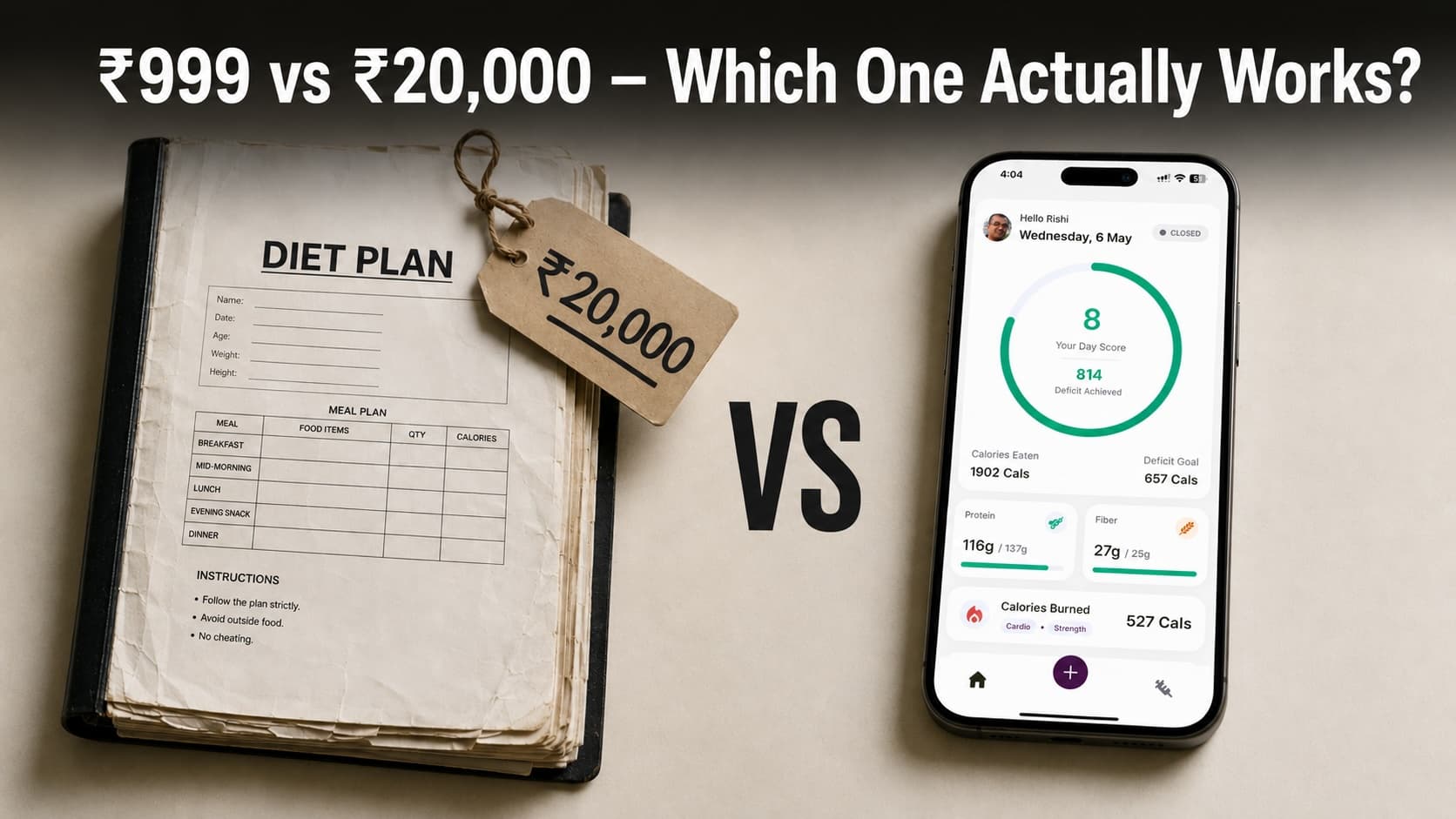
Why a ₹999 Calorie Tracker Will Outperform Your ₹20,000 Diet Program
And why the weight loss industry is quietly hoping you never figure this out.
The Number Nobody Puts in the Brochure
Let's start with a calculation the Indian weight loss industry would rather you did not do.
The average structured weight loss program in India — a nutritionist-guided meal plan, weekly check-ins, customised diet charts, WhatsApp accountability — costs somewhere between ₹2,500 and ₹4,000 per month. The average duration of a meaningful weight loss journey is six months. Run the numbers and you are looking at ₹15,000 to ₹24,000 for a single programme cycle.
Call it ₹20,000. That is a conservative, reasonable estimate for what Indians spend on a structured diet programme before they either hit their goal, give up, or — most commonly — achieve results they cannot sustain because they never actually understood how those results happened.
₹20,000. For a plan someone else designed. For a food list someone else approved. For a journey where someone else holds all the knowledge and you hold the bill.
There is a better way. And it costs less than your monthly mobile recharge plan.
The Hidden Problem With Structured Diet Plans
Before we get to the solution, it is worth being honest about why structured diet plans fail so many people — not because the nutritionists are incompetent, but because the model has a fundamental design flaw.
Structured plans are built around compliance. The entire logic depends on you following a prescribed food list with specific ingredients, specific portions, and specific meal timings — consistently, for months — in the real conditions of your actual life.
And here is where Indian reality intervenes in spectacular fashion.
You live in a family of four. Your diet plan specifies grilled chicken with quinoa and steamed vegetables for dinner. Your mother has made rajma chawal. Your kids are demanding pasta. Your spouse is looking at you with a combination of sympathy and mild irritation as you stand in the kitchen preparing a completely separate meal for yourself at 8pm after a full day of work.
This is not a willpower problem. This is a design problem. A diet plan that requires you to eat differently from your family, source special ingredients, and maintain a completely separate food routine is not a sustainable lifestyle intervention. It is a temporary performance — one that most people can sustain for a few weeks before the social and logistical friction becomes too high.
And when the plan ends — whether you completed it successfully or abandoned it in week seven — what are you left with? A PDF of meal plans you will never look at again. No understanding of why the programme worked. No framework for making your own food decisions going forward. No ability to course-correct independently the next time weight creeps back.
You paid ₹20,000 to borrow someone else's knowledge for six months. And you gave it back when the programme ended.

The Science of Weight Loss Is Embarrassingly Simple
Here is the thing the weight loss industry is structurally incentivised to obscure: the fundamental mechanism of weight loss is not complicated.
Your body loses weight when it consistently burns more energy than it consumes. That is it. That is the complete scientific foundation of every diet programme, every meal plan, every nutritionist consultation, and every transformation story you have ever seen.
Create a consistent daily calorie deficit of 300 to 500 calories — meaning consume 300 to 500 fewer calories than your body burns each day — and weight loss is not a possibility. It is a mathematical certainty. Biology does not negotiate with a sustained energy deficit.
Everything else — the meal timing, the macro ratios, the specific food choices, the supplements — operates on top of this foundation. It can optimise the process, improve the quality of the weight lost, and support your energy and health during the journey. But none of it overrides the fundamental equation.
If you understand this equation and have a tool that helps you stay within it — you have everything you need to lose weight.
What a Good Calorie Tracker Actually Does
A calorie tracker is not just a place to log food. A good one — built on accurate, comprehensive food data — is a complete nutritional decision support system that fits in your pocket and costs a fraction of what a human coach charges.
Here is what it does for you in practice.
It tells you your daily calorie target based on your weight, height, age, activity level, and goal. It tracks what you eat against that target in real time. It shows you your macronutrient breakdown — how much protein, carbohydrate, and fat you have consumed — so you can make sure you are losing fat rather than muscle. And it gives you the information you need to make your own food decisions, in your own context, on your own terms.
That last part is the one that changes everything.
When you track your own food, you learn. You discover that your evening chai with two spoons of sugar is costing you 120 calories a day. You realise that a generous pour of cooking oil adds 200 calories to a sabzi that would otherwise be entirely reasonable. You find out that dal and rice together are not the caloric catastrophe fitness influencers have led you to believe — but that the portion size you have been serving yourself is about twice what your deficit allows.
This knowledge is yours permanently. It does not expire when your programme ends. It does not require a monthly subscription to a human who holds it on your behalf. It becomes the framework you use to make food decisions for the rest of your life.

The Indian Food Problem — And Why It Matters
Here is where most global calorie tracking apps fail Indian users, and where the quality of the food database becomes critical.
The calorie content of Indian food is notoriously difficult to standardise. A katori of dal makhani prepared at home with moderate butter is a completely different nutritional proposition from the same dish at a restaurant where butter is applied with the enthusiasm of a Punjabi wedding. A medium roti varies significantly in calories depending on whether it was made with a teaspoon of ghee or half a tablespoon. A thali at a dhaba and a thali at home share a name and approximately nothing else in terms of nutrition.
A calorie tracker built on a Western food database — or a generic database that treats "Indian curry" as a single entry — is not going to give you the accuracy you need to make confident decisions about Indian food. You will log your meal, receive a number that may be significantly off reality, and make decisions based on data you cannot trust.
This is why the Indian food database underneath a calorie tracker matters as much as the tracker itself. The combination of accurate Indian food data and a well-designed tracking experience is what makes the tool actually usable in the Indian context — not just theoretically valid.

You Decide When the Gulab Jamun Fits
Here is the part that nobody in the structured diet programme world will tell you, because their entire model depends on you believing the opposite.
You can eat everything you love and still lose weight. You just need to make it fit your deficit.
A calorie tracker does not tell you what you cannot eat. It tells you what your numbers look like and lets you decide. If today's deficit allows for a gulab jamun after dinner — have the gulab jamun. If Saturday's birthday party means going over your target — go over your target, enjoy the party, and course-correct on Sunday.
No coach texting you disappointed emojis at 10pm. No guilt spiral that derails your entire week because you had one unplanned slice of pizza. No arbitrary list of forbidden foods that makes social eating an exercise in anxiety management.
Just you, your numbers, and the quiet confidence of someone who understands exactly what is happening in their own body.
This is not a compromise version of weight loss. This is what sustainable weight loss actually looks like — a flexible, informed, autonomous relationship with food that you maintain not because someone is checking up on you, but because you understand why it works and it fits into your real life.

The Gamification Layer That Makes It Stick
Understanding the science is one thing. Staying consistent is another. And this is where a well-designed calorie tracking app does something that a static meal plan fundamentally cannot — it makes the process engaging.
Streaks that reward consistency. Daily scores that tell you at a glance whether today was a good nutritional day. Progress visualisations that show you the trend over weeks and months. Small wins that compound into identity-level change — the shift from "someone trying to lose weight" to "someone who understands their nutrition."
This is the behavioural science of habit formation applied to food tracking. And it is why people who build a calorie tracking habit maintain it far longer than people who follow a structured plan — because the tracker adapts to their life rather than requiring their life to adapt to it.

The Final Calculation
₹999 per year for a calorie tracking app with solid Indian food data versus ₹20,000 for a structured diet programme that ends, takes its knowledge with it, and leaves you dependent on the next programme when the weight returns.
The tracker teaches you. The programme teaches the coach.
And the money you save? You are genuinely going to need it. Not for supplements. Not for the next diet programme.
For new clothes. Because in six months of consistent tracking, nothing in your current wardrobe is going to fit anymore.
That is an excellent problem to have.
About Caddy Caddy is India's smartest nutrition companion — built on one of India's most comprehensive food databases, designed around Indian eating patterns, and priced at a fraction of what traditional weight loss programmes cost. Whether you are on a GLP-1 medication or approaching weight loss through nutrition alone, Caddy gives you the knowledge, the tools, and the autonomy to make it work — on your terms. Visit getcaddy.ai