
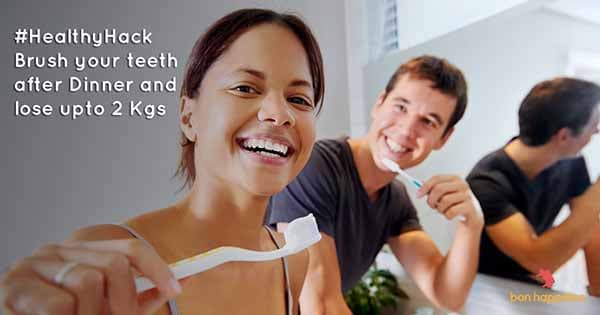
Why Brushing Your Teeth After Dinner Might Be the Best Weight Loss Hack You Have Never Tried
It sounds ridiculous. The science says otherwise.
The Claim That Sounds Like a Joke
Brush your teeth after dinner to lose weight.
Go ahead and read that again. It sounds like the kind of advice you would find on a wellness blog that also recommends drinking warm turmeric water at 4am and sleeping with crystals under your pillow.
But stay with us. Because buried inside this apparently absurd suggestion is a genuinely fascinating piece of behavioural science — one that connects the history of toothpaste, the mechanics of habit formation, and the very specific way your brain sabotages your weight loss goals between 9pm and midnight.
A Brief History of Mint — And Why It Has Nothing to Do With Your Health
Before we get to the weight loss part, a detour into toothpaste history that is worth taking.
The early versions of toothpaste contained no mint whatsoever. Brushing teeth was not a daily ritual for most people — it was an occasional, inconsistent habit that required significant effort and motivation to maintain. Dental hygiene existed as a concept. Daily brushing as an automatic morning behaviour did not.
Then Pepsodent changed everything. Not by improving the cleaning effectiveness of their toothpaste. Not by discovering a new dental health benefit. But by adding mint.
The cool, tingling sensation that mint produces in the mouth created what behavioural scientists call a habit loop — a neurological pattern consisting of a cue, a routine, and a reward. The cue was waking up. The routine was brushing. The reward was the fresh, tingling, clean feeling that mint produced. That reward was so immediately pleasurable and so distinctly recognisable that it created a subconscious craving — an anticipation of the minty sensation that pulled people toward the toothbrush every morning without conscious effort.
Here is the extraordinary part: mint has no meaningful dental health benefit. None. The tingling sensation is essentially a pleasant side effect of a flavour compound. The entire daily brushing habit that hundreds of millions of people now perform automatically — the habit that genuinely does protect dental health through the mechanical act of brushing — was built on a sensory reward that is, in clinical terms, completely irrelevant to the outcome.
The lesson here is profound and directly applicable to weight loss: habits are built by rewards, not by logic. You do not build a lasting habit by understanding why it is good for you. You build it by experiencing something immediately pleasurable when you do it.
Remember that. It is the key to everything that follows.
The 9pm Problem Nobody Talks About Honestly
Here is a scenario that will feel familiar to approximately everyone reading this.
You have had a satisfying dinner. A proper meal — dal, sabzi, roti or rice, maybe a small sweet at the end. You are genuinely full. You sit down to watch something on your phone or TV. Forty-five minutes later your hand is inside a packet of chips, or you are standing in front of the open refrigerator staring at the leftover mithai from last weekend, or you are three biscuits into a pack that you opened "just for one."
You are not hungry. You know you are not hungry. And yet here you are.
This is not a willpower failure. This is a habit loop running on autopilot.
The cue is the couch, the TV, the relaxed evening state. The routine is reaching for a snack. The reward is the combination of flavour, texture, and the mild dopamine hit of eating something pleasurable. Your brain has run this programme so many times that it no longer requires a conscious decision. It just runs.
And this matters enormously for your weight, for a reason that is worth understanding properly.

Why Late Night Eating Specifically Matters for Weight
The human body is not a machine that processes calories identically regardless of when they are consumed. While the total calorie balance over time is the primary driver of weight gain and loss, the timing of eating interacts with your body's hormonal and metabolic rhythms in ways that make late night eating specifically problematic.
In the hours between dinner and sleep, your body is gradually transitioning from active metabolic processing to rest and repair. Insulin sensitivity — your cells' ability to efficiently process glucose — decreases as the evening progresses. Your digestive system slows. Your body's capacity to direct energy toward immediate use rather than storage reduces.
The practical consequence is that calories consumed late in the evening are more likely to be stored as fat than the same calories consumed earlier in the day. They are also more likely to disrupt the quality of your sleep — elevated blood glucose and active digestion in the hours before sleep interfere with the deeper sleep stages where genuine physical restoration occurs.
And disrupted sleep, it turns out, directly elevates the hunger hormones ghrelin and leptin in ways that make you more likely to overeat the following day. Late night snacking today makes tomorrow's eating harder to control. The cycle compounds.
Beyond weight specifically, consistent late night eating is associated with increased belly fat accumulation, worsened acid reflux and digestive discomfort, and in people with metabolic risk factors, meaningfully elevated blood glucose levels that contribute to insulin resistance over time.
This is not a small issue. For the average Indian urban adult who eats dinner around 8pm and sleeps around 11pm, the three hours between dinner and sleep are a metabolic window where additional calorie consumption does disproportionate damage relative to its size.
How the Toothbrush Closes That Window
This is where the toothpaste history becomes practically useful.
Brushing your teeth immediately after dinner — not before bed, not whenever you remember, but as the deliberate final act of your evening meal — does two specific things simultaneously.
First, it creates a psychological full stop. The clean, fresh, minty sensation in your mouth signals completion — the meal is over, the kitchen is closed, the eating part of the evening is done. This is not a trivial signal. Human behaviour responds strongly to environmental and sensory cues that mark transitions. The minty freshness is a sensory transition marker that your brain learns to associate with the end of eating, not the continuation of it.
Second, it introduces what behavioural scientists call friction into the late night snacking habit loop. The cue — the couch, the TV, the relaxed state — still fires. But when your hand moves toward the chips, the clean mouth intervenes. There is now a small but real psychological cost to eating: you will have to brush again. That cost does not need to be large to be effective. Habit research consistently shows that even tiny increases in the friction cost of a behaviour significantly reduce its frequency. You do not need to make late night snacking impossible. You just need to make it slightly less automatic.
The combination of the sensory full stop and the friction cost creates a pause between the cue and the routine — and that pause is where conscious choice re-enters the picture. You are not relying on willpower to resist the chips. You are using good habit design to give your willpower a fighting chance.
What This Actually Means for Your Weight
The numbers here are modest but real and they compound significantly over time.
The average Indian late night snacking session — a packet of biscuits, a small bowl of ice cream, a handful of chips, a few pieces of mithai — adds somewhere between 150 and 400 calories to the day's total. Call it 250 calories on average, five nights a week.
That is 1,250 calories per week. Approximately 5,000 calories per month. Roughly 60,000 calories per year — the equivalent of about 8 kilograms of body fat.
Simply stopping consistent late night snacking — through whatever mechanism works for you, including the post-dinner toothbrush — can produce weight loss of 1 to 2 kilograms over six months without changing a single other thing about your diet or lifestyle. No meal plan. No calorie counting. No gym membership. Just the removal of one habitual behaviour that your body did not need and was not processing efficiently anyway.
This is not dramatic. It is not the kind of transformation that makes for compelling before and after photos. But it is real, it is sustainable, and it is the kind of quiet compounding change that makes a genuine difference to your metabolic health over years rather than weeks.
Building the Habit That Builds the Habit
The final piece of this is the most important and the most often overlooked.
Brushing your teeth after dinner only works as a weight loss strategy if it becomes automatic — if it becomes its own habit loop rather than a conscious daily decision that requires effort and motivation to maintain.
This means the same principles that made mint toothpaste create a daily brushing habit apply to creating the post-dinner brushing habit itself. You need a consistent cue — finishing dinner. You need a routine — going directly to brush, not sitting down first, not "in a few minutes." And you need a reward — the minty freshness itself, the same sensory pleasure that built the morning brushing habit in the first place.
For most people, making this automatic takes two to three weeks of deliberate repetition. After that, the habit runs itself. The cue fires, the routine follows, and the reward lands — without conscious effort, every evening.
One final practical note: the toothpaste matters. Use something with a strong, genuine mint flavour. Not because mint has health benefits — we have established that it does not — but because the stronger and more pleasurable the minty sensation, the stronger the reward signal, and the faster and more durably the habit forms.
The Chips and Ice Cream Are Not Gone Forever
A quick reassurance for anyone who has read this far and is feeling pre-emptively sad about their evening snacks.
This is not about elimination. It is about timing and context.
The problem with chips at 10:30pm while watching TV is not the chips. It is the 10:30pm, the unconscious autopilot, and the metabolic window. The same chips at 4pm on a Sunday afternoon, consciously chosen, fitting within your daily calorie balance — that is a completely different situation with completely different metabolic consequences.
Good nutrition is not about never eating the things you love. It is about eating them in the right context, at the right time, with enough awareness that they are a choice rather than a script.
The post-dinner toothbrush helps you make that distinction. It closes the evening eating window. It preserves the pleasure of the snack for moments when it genuinely fits. And it does all of this without a diet plan, a coach, or a single gram of quinoa.
The Bottom Line
The best weight loss strategies are not always the most dramatic ones. They are the ones that work with your brain's existing wiring rather than against it — that use the mechanics of habit formation to make the healthy choice the automatic choice.
Brushing your teeth after dinner is exactly this kind of strategy. It is free. It takes ninety seconds. It has a dental health benefit as a bonus. And used consistently, it can remove hundreds of daily calories from your life so quietly and effortlessly that six months from now you will barely remember making a change.
The mint did not make Pepsodent's toothpaste clean your teeth better. But it made millions of people brush their teeth every day. That is the power of a well-designed habit.
Use it.
About Caddy Caddy is India's no-BS nutrition and weight loss companion — built for Indians, powered by one of India's most comprehensive food databases, and designed around the real behavioural challenges of eating well in Indian life. Whether you are on a GLP-1 medication or approaching weight loss through nutrition and lifestyle, Caddy helps you build the habits that actually stick. Visit getcaddy.ai