
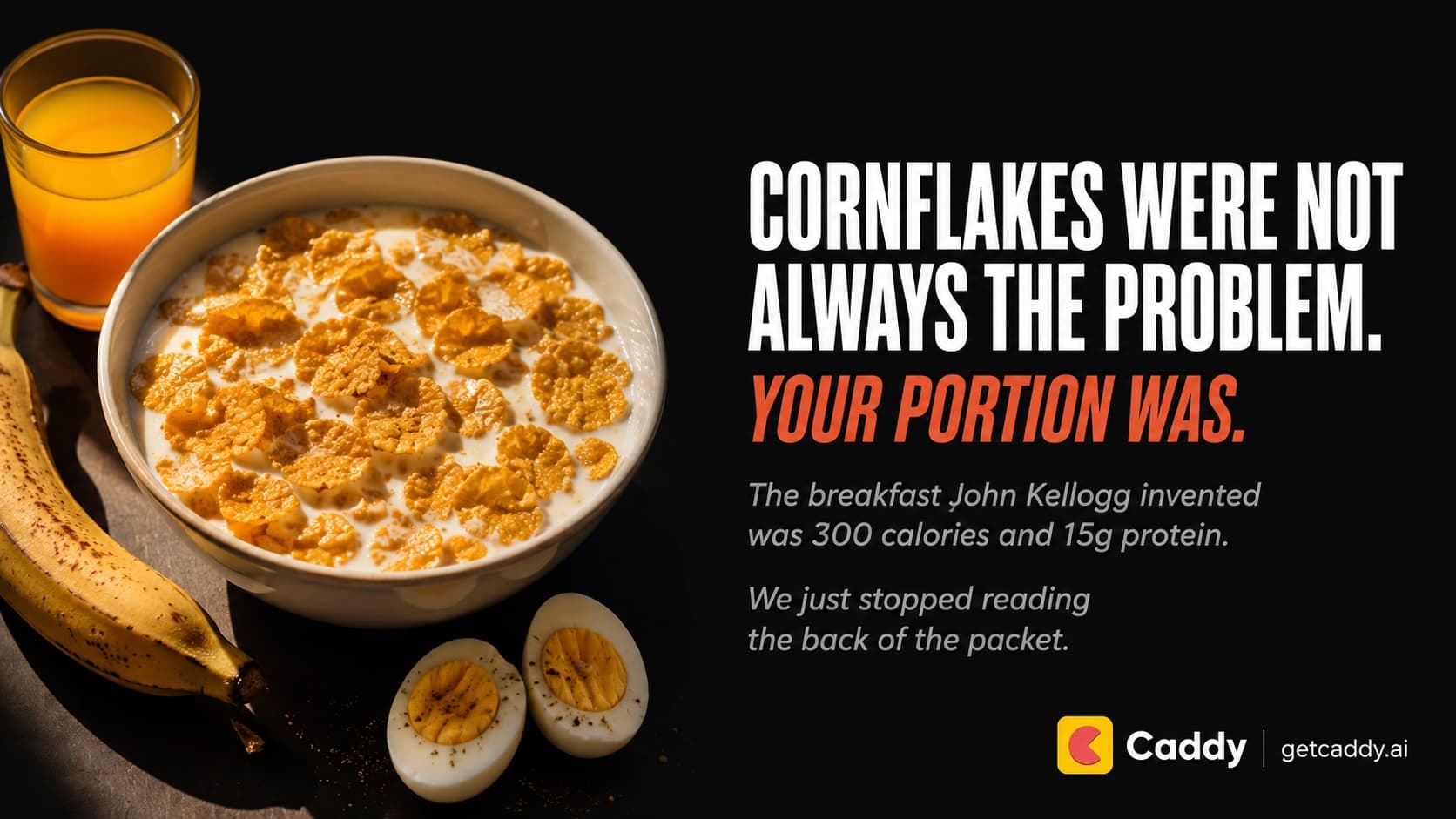
Breakfast Cereals Are Not the Problem. Your Portion Is.
Written by Rishi Bhojnagarwala
Medically Reviewed by Dr. Hetal Pal, PhD in Nutrition Science
John Harvey Kellogg did not invent an unhealthy breakfast. He invented a sensible one. Here is how a century of marketing turned it into something else.
A Brief History of Cornflakes
In the early 1900s, John Harvey Kellogg — yes, the same Kellogg whose name is on virtually every cereal box in your supermarket today — created cornflakes with a specific and rather humble purpose.
He wanted to encourage children to drink more milk.
The logic was simple. Milk alone was boring. Add something crunchy and slightly sweet to it, and suddenly children would eat their breakfast willingly, consume the nutritional benefits of milk, and start the school day properly fuelled. The cereal was a vehicle for the milk. The milk was the point.
The original serving he had in mind was approximately 30 grams of cereal in a generous bowl of milk — roughly 200 millilitres. The cereal was pre-cooked, convenient, inexpensive, and easy to prepare. For a busy household feeding multiple children in the morning, it was a practical solution to a real problem.
What did that breakfast actually contain nutritionally?
30 grams of cornflakes: approximately 108 calories, 25 grams of carbohydrates, 2 grams of protein, negligible fat, 1 gram of fibre.
200ml of full-fat milk: approximately 130 calories, 9 grams of carbohydrates, 7 grams of protein, 7 grams of fat.
One boiled egg — a common addition: approximately 75 calories, 0.5 grams of carbohydrates, 6 grams of protein, 5 grams of fat.
Total breakfast: approximately 300 calories, 34 grams of carbohydrates, 15 grams of protein, 12 grams of fat.
For a growing child or a moderately active adult, this is a nutritionally reasonable breakfast. The carbohydrates provide immediate energy. The protein — split between milk and egg — supports satiety and muscle function. The fat from milk and egg provides essential fatty acids. The calorie count is appropriate for a morning meal before a day of activity.
This was the breakfast John Kellogg invented. It was not a problem.

What Happened Over the Next Century
The problem was not the cereal. The problem was what happened to how we consumed it over the following hundred years.
At some point — driven by a combination of portion size inflation, changing breakfast habits, and increasingly aggressive marketing of larger serving quantities — the ratio between cereal and milk quietly flipped.
The generous bowl of milk with a modest amount of cereal became a generous bowl of cereal with a modest amount of milk.
Today, the typical way most Indian households eat breakfast cereal looks like this: a large bowl containing 80 to 90 grams of cereal, topped with approximately 100 millilitres of milk — just enough to wet the cereal.
That breakfast looks like this nutritionally:
80-90 grams of cereal with 100ml milk: approximately 400 calories, 75 grams of carbohydrates, 6 grams of protein, 4 grams of fat.
Compare this to the original. Calories have increased by a third. Carbohydrates have more than doubled. Protein has dropped by more than half. The meal that was designed to be a vehicle for milk nutrition has become a bowl of refined carbohydrates with a small amount of milk for colour.
To make it more complicated, cereal manufacturers — responding to growing health consciousness and exactly the kind of nutritional critique we just described — started adding sugar, flavouring, and artificial colours to increase palatability. This gave health-conscious consumers a legitimate reason to be suspicious of regular cereals.

The Premium Cereal Industry Was Born
The response to unhealthy mainstream cereals was predictable. A new category of premium breakfast cereals appeared — muesli, granola, ancient grain flakes, high-protein cereals, fibre-fortified varieties. These products positioned themselves as the solution to the nutritional problems of regular cornflakes.
And they do, genuinely, have better nutritional profiles on paper.
A typical premium muesli at 50 grams delivers approximately 224 calories, 34 grams of carbohydrates, 6 grams of protein, 7 grams of fat, and 5 grams of fibre. Compared to regular cornflakes at the same weight, this is better — more fibre, more complex carbohydrates, better fat profile.
But here is where the comparison gets interesting.
If you take 30 grams of regular cornflakes, add 200ml of full-fat milk, one boiled egg, and a piece of fruit — you get approximately 375 to 400 calories with 21 grams of protein, 40 grams of carbohydrates, 8 grams of fibre, and 17 grams of fat.
That nutritional profile beats almost every premium breakfast cereal at almost any serving size. The protein is significantly higher. The fibre is comparable or better. The carbohydrate to protein ratio is healthier. And the total cost — regular cornflakes, an egg, a banana — is a fraction of the premium muesli price.
The premium cereal industry solved the wrong problem. The problem was not the cereal. It was the absence of protein and fibre from the breakfast and the overconsumption of the cereal itself. Adding nuts to the cornflakes addressed the symptom while leaving the cause untouched.
The Back-of-Pack Information You Are Not Reading
Here is something worth knowing. Most mainstream cereal brands — including Kellogg's, Quaker, and others available in Indian supermarkets — still print the nutritional information on the back of their packets based on a 30-gram serving with 200ml of milk.
They have not forgotten the original serving size. The information is right there. The recommended preparation is still the one that produces a reasonable nutritional outcome.
The front of the pack shows a large overflowing bowl for marketing reasons. The back of the pack shows 30 grams because that is the accurate serving size.
This is not a conspiracy. It is simply the gap between honest nutritional labelling and aspirational product photography — and most consumers read the front of the pack, not the back.
The Muesli Trap
Premium muesli and granola products have a specific overconsumption problem that is worth addressing separately.
Because these products are positioned as healthy, the portion control instinct that might govern consumption of "unhealthy" regular cereal does not operate. A person who might stop at 30 grams of cornflakes because it is "bad" will comfortably eat 100 grams of premium muesli because it is "good."
100 grams of premium muesli with 100ml of milk: approximately 450 to 500 calories, 65 to 75 grams of carbohydrates, 10 to 12 grams of protein.
This is nutritionally worse than the original 30-gram cornflakes with milk and egg breakfast — at roughly double the cost.
The health halo effect of premium cereals creates the conditions for significant overconsumption. The guilt removal that comes with choosing a "healthy" option removes the portion awareness that might otherwise operate as a natural limit.
This is the same overconsumption paradox at work in clean label chocolates, protein cookies, and date-sweetened snack bars — the healthier the positioning, the less restraint the consumer applies, and the higher the actual caloric intake.
The Simple Fix
Whichever cereal you prefer — regular cornflakes or premium muesli — the single most important variable in the nutritional outcome of your breakfast is not which product you choose. It is how much of it you eat, how much milk you add, and what you pair it with.
The original formula still works.
30 grams of your chosen cereal. 200ml of milk. One boiled egg. A piece of fruit for fibre and micronutrients.
This breakfast costs approximately ₹30 to ₹50 depending on the cereal you choose. It takes approximately three to four minutes to prepare. It delivers 350 to 400 calories, 18 to 22 grams of protein, 8 to 10 grams of fibre, and a macronutrient balance that will keep you satiated through the morning.
You do not need to upgrade your cereal brand. You need to upgrade your understanding of what a serving actually looks like.
The difference between a healthy cereal breakfast and an unhealthy one is approximately 60 grams of cereal, 100 millilitres of milk, and one egg. Not the brand name on the box.
What to Look for When Buying Cereal
If you are buying cereal in India and want to make an informed choice, here is the practical guidance.
Check the serving size on the back of the pack. If it says 30 grams, that is the serving size. Not the amount in the picture on the front.
Check the sugar content per 100 grams. Regular cornflakes contain approximately 7 to 8 grams of sugar per 100 grams. Flavoured or chocolate cereals can contain 30 to 40 grams. This is the real differentiation between regular and problematic cereals — not the grain type.
Check the protein content. Most regular cereals are low in protein — 2 to 3 grams per 30-gram serving. This is fine if you add milk and an egg. It is not fine if the cereal is your only breakfast.
Do not pay a premium for fibre fortification. Fibre is abundantly available from fruit and vegetables at a fraction of the cost. A banana alongside your regular cornflakes adds more fibre than most premium fibre-fortified cereals.
The Bottom Line
Breakfast cereals are not unhealthy. Eating 90 grams of cereal with 100ml of milk and nothing else is an unbalanced breakfast — but that is a portion and pairing problem, not a cereal problem.
John Kellogg's original formula — modest cereal, generous milk, an egg alongside — remains nutritionally sound more than a century later. The premium cereal industry built a business on solving a problem that could have been solved by reading the back of the original box.
Know your portion. Add your protein. Have the fruit.
The breakfast you already have in your kitchen is probably fine.
About Caddy Caddy tracks what you actually eat for breakfast — including your cereal, your milk, your egg, and the banana you had on the way out. Built on India's most comprehensive food database, Caddy gives you one honest daily score so your decisions are based on what you actually ate, not what the front of the box suggested. Visit getcaddy.ai