
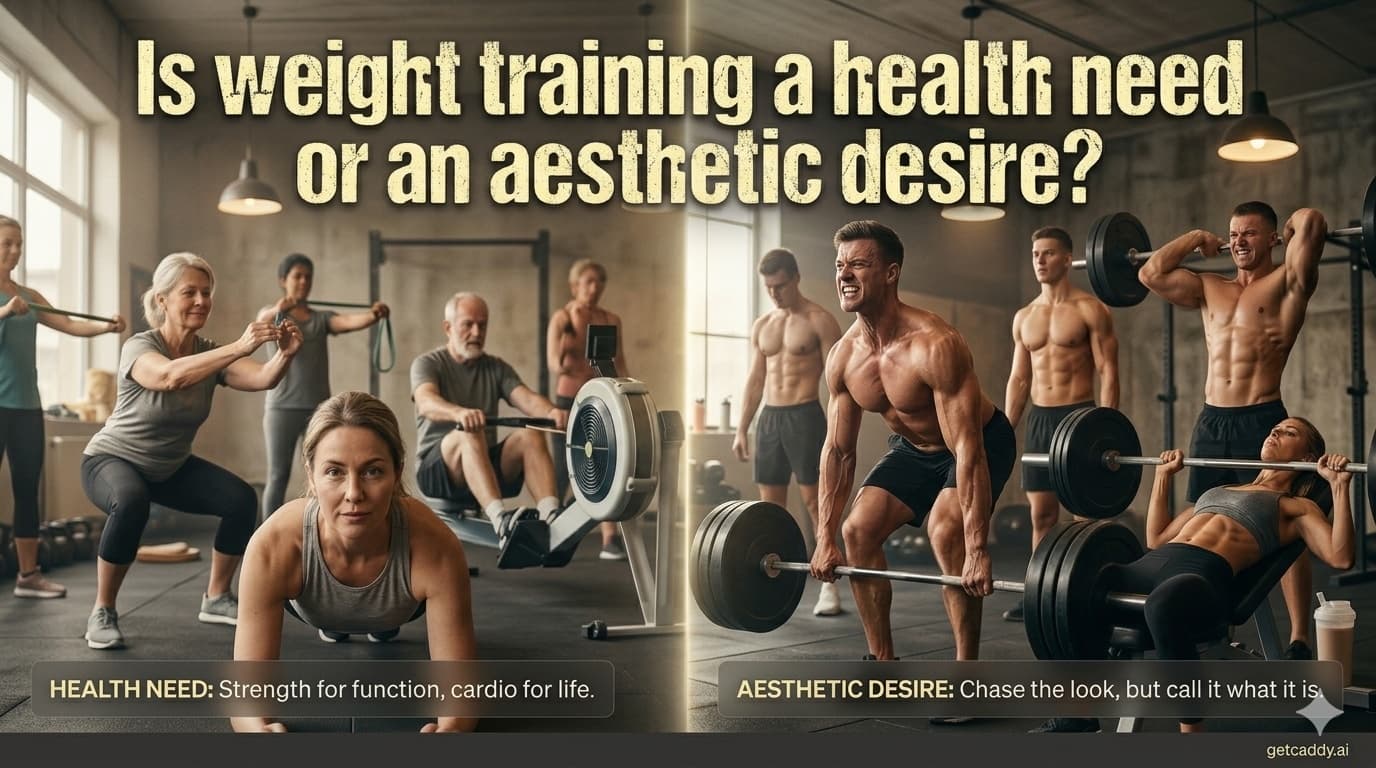
Is Strength Training a Health Need or an Aesthetic Desire? What the Science Actually Says
Written by Rishi Bhojnagarwala
Medically Reviewed by Dr. Hetal Pal, PhD in Nutrition Science
The fitness industry has one of the most effective marketing operations ever built. It convinced a generation that health lives inside a gym. Here is what the evidence actually shows.
The Question Nobody in the Fitness Industry Wants You to Ask
How much exercise do you actually need for a long, healthy life?
Not for a six pack. Not for a 100kg deadlift. Not for visible muscle definition or a specific body composition. Just for genuine health — the kind that keeps your heart strong, your metabolism functional, your joints mobile, and your risk of chronic disease low as you age.
It is a surprisingly simple question. And the answer, when you follow the evidence rather than the industry, is surprisingly accessible.
But accessibility does not sell gym memberships. It does not move protein powder. It does not justify a personal trainer at four thousand rupees an hour. And so the fitness content ecosystem — worth over $180 billion globally — has spent decades making the answer feel far more complicated, far more equipment-dependent, and far more gym-exclusive than the science actually requires.
This piece is about drawing the line that the industry does not want you to see. The line between what your body genuinely needs for health and longevity, and what is being sold to you as necessity when it is really desire.
What Longevity Science Actually Measures
If you want to understand what exercise science says about living longer and healthier, start with the metric that matters most.
VO2 max. It is your body's capacity to consume and use oxygen during sustained physical effort — essentially, a measure of your cardiovascular and aerobic fitness. And it is, by a significant margin, the strongest predictor of all-cause mortality that exercise science has identified.
Studies consistently show that people in the top quartile of VO2 max for their age group have dramatically lower rates of cardiovascular disease, metabolic disease, and early death compared to those in the bottom quartile. The magnitude of this effect rivals or exceeds the impact of cholesterol levels, blood pressure, smoking status, and BMI.
Peter Attia, one of the most widely followed longevity physicians globally, has described low VO2 max as the single most powerful modifiable risk factor for early death. Not low protein intake. Not insufficient muscle mass. Low aerobic capacity.
You build VO2 max through cardiovascular exercise. Sustained, rhythmic, moderately intense activity that elevates your heart rate over time. Walking. Jogging. Cycling. Swimming. Dancing. Any form of movement that gets your heart working consistently.
None of this requires a gym. None of this requires equipment. And almost none of it appears in the content put out by the fitness industry's largest and most followed voices.

The Undervalued Power of Walking
The most evidence-backed, accessible, and consistently underrated form of exercise in existence is walking.
Research across large population studies has shown that walking 7,000 to 10,000 steps per day is associated with dramatically reduced risk of cardiovascular disease, Type 2 diabetes, depression, cognitive decline, and early mortality. A brisk 45-minute walk delivers measurable improvements in insulin sensitivity, blood pressure, and mood that rival the effects of more intense exercise in sedentary populations.
Walking is free. It requires no instruction. It carries virtually no injury risk. It is sustainable across decades and across all fitness levels. It is something that almost every human being on earth can do regardless of income, geography, or physical condition.
And it is almost completely absent from serious fitness content. Because there is no business model attached to it.
You cannot sell a walking subscription. You cannot build a walking supplement stack. Walking does not require a coach, a programme, or a carefully periodised training plan. The fitness industry's commercial ecosystem depends on complexity, equipment, and expertise — and walking threatens all three.
Where Strength Training Actually Fits
This is where the argument requires precision — because dismissing strength training entirely would be as misleading as overstating its necessity.
Resistance training has genuine, well-established health benefits that cardiovascular exercise alone cannot fully replicate. Muscle mass is directly linked to insulin sensitivity and glucose disposal — critical for metabolic health and particularly relevant for Indians, who have a documented genetic tendency toward insulin resistance at lower body weights. Strength training improves bone density, reducing fracture risk in older age. It supports functional independence — the ability to carry groceries, climb stairs, get up from the floor — that determines quality of life in later decades.
After the age of 40, muscle mass declines at approximately 1% per year without active resistance training. This is not an aesthetic concern. It is a clinical one, particularly in a country where hip fractures in elderly people carry significant mortality risk and where sarcopenic obesity — low muscle combined with high fat — is increasingly prevalent.
So strength training matters. The question is how much.
And here the evidence is clear, even if the industry does not want it to be: the health threshold for strength training is two sessions per week of moderate resistance exercise. Full body. Compound movements. Achievable entirely with bodyweight — squats, lunges, push-ups, rows using a table or a resistance band. No gym required. No deadlifts. No skull crushers.
Everything beyond this threshold delivers returns — but they are primarily aesthetic and performance returns. More muscle. Better definition. Higher strength numbers. All legitimate goals. But not health goals in the clinical sense.
The fitness industry has invested enormously in blurring this line. Because the commercialisable part of fitness — the memberships, the supplements, the coaching programmes, the equipment — lives almost entirely above it.

The Gym Lobby Question
Is there a coordinated lobby suppressing cardio in favour of gym-based training? Not in the formal sense that pharmaceutical or agricultural lobbies operate.
But there is something arguably more powerful — a commercial ecosystem with perfectly aligned incentives that does not need to coordinate because everyone in it benefits from the same narrative.
Gym chains need members who believe the gym is essential. Personal trainers need clients who believe complexity requires expertise. Supplement brands need consumers who believe their goals require product support. Fitness influencers need audiences who believe that what they are doing is the standard. The algorithm rewards content that is visually dramatic — and a heavy deadlift is more dramatic than a morning walk.
The result is a content landscape that systematically underrepresents the most effective, most accessible, and most evidence-backed forms of exercise in favour of the most commercially exploitable ones. This is not a conspiracy. It is just the natural outcome of commercial incentives operating at scale.
What This Means for Indians on GLP-1 Medications
This question has a specific and urgent dimension for the growing number of Indians using GLP-1 receptor agonists like Ozempic, Wegovy, or Mounjaro for weight loss.
GLP-1 medications are highly effective at reducing total body weight. But rapid weight loss — of any kind, medication-assisted or otherwise — carries a risk of muscle loss alongside fat loss. Studies suggest that without deliberate resistance training, a meaningful proportion of weight lost on GLP-1 medications comes from lean mass rather than fat alone.
This makes the strength threshold question directly clinically relevant for GLP-1 users. The minimum effective dose of resistance training — two sessions per week of bodyweight or light resistance exercise — is not optional for someone losing significant weight on medication. It is the intervention that protects muscle mass, preserves metabolic rate, and ensures that the weight being lost is the weight that should be lost.
Simultaneously, cardiovascular exercise on GLP-1s supports the heart health improvements that make weight loss genuinely meaningful for longevity — not just a number on a scale.
The combination of minimum effective strength training and consistent cardio, for a GLP-1 user, is both achievable without a gym and more important than ever. That is a message that almost no fitness content directed at GLP-1 users in India is currently delivering.
Drawing the Line
Here is the honest summary that the fitness industry will not give you.
For health and longevity, you need two things. Cardiovascular fitness built through consistent aerobic activity — walking, jogging, cycling, swimming — for at least 150 minutes per week at moderate intensity. And basic muscular strength maintained through two sessions per week of resistance exercise, achievable entirely without a gym.
Everything beyond this is legitimate pursuit. Athletic performance. Aesthetic goals. Personal challenge. Competitive sport. These are all worthwhile. But they are not health requirements. They are life choices.
A six pack is a vanity goal. There is nothing wrong with vanity goals. But they should not be marketed as medical necessity to people who are already overwhelmed trying to navigate their metabolic health.
Chase health. It is simpler, cheaper, and more accessible than the industry needs you to believe.
About Caddy Caddy is India's no-BS health and nutrition companion, built for Indians on GLP-1 medications and anyone serious about sustainable weight loss. Caddy gives you guidance built around what the evidence actually shows — not what the industry needs you to believe. Visit getcaddy.ai